Wednesday, June 30, 2010

Is Jon Runyan Qualified to be a Congressman?

Recently, Jon Runyan held his first press conference.  According to the Press of Atlantic City, he outlined his approach, which is not much different than the 1994 Republican Contract on America.  Runyan’s eight-point plan is to enact eight specific tax cuts.  Even though it has been proven time and again that tax cuts simply increase the deficit and don’t create jobs, Runyan’s platform is a Bush-like gift to corporations and the wealthiest Americans.

To balance the budget, Runyan calls for cutbacks in discretionary spending, but he names not a single program that he would cut.  And he calls for cutting back government employment to what he calls the “pre-Obama” levels, despite the fact that historically government has grown under Republican administrations.  (According to the US Office of Personnel Management, there are 16% fewer government employees now than there were at the end of the Reagan administration, even though the US population has grown 25% since then.)

Runyan exempts defense spending from his cuts, despite the fact that our Middle East oil wars have cost us over a trillion dollars since 2001 and we have troops deployed all over the world.

So unless the former dirtiest player in the NFL provides more specifics about his platform, we can only conclude that he is simply parroting Tea Bag talking points and there’s no substance to his approach.  I’m sure that if he is elected, he won’t be the craziest person in Congress.  After all, Michele Bachmann, Steve King, and Louis Gohmert have had a head start.  This year, the voters in New Jersey’s Third Congressional District will choose between a 300 pound Sarah Palin clone and a moderate Republican disguised as a Democrat.  We deserve better.

Monday, June 28, 2010

Killing Bees with Machine Guns

When you have an 800 pound gorilla in a room, a shotgun may not be enough to solve the problem, and in fact could exacerbate it if he gets mad at you.  There are other weapons you can use that are more effective, but the solution is a bit more drastic.  An automatic machine gun with a large supply of rounds would be enough to eliminate the threat.  But now, assume that in addition to the gorilla, there is a large swarm of killer bees in the room with you also.  The machine gun is useless against this threat, and another weapon must be found.

This is analogous to the problem Americans face today.  Our states and the nation are facing unprecedented financial difficulties.  But even though the threats are similar and the problems at the state and national levels are related, the weapons we must use to kill off these threats must be different.

For the most part, we are attacking both problems around the edges and have not been effective in executing an effective frontal attack on these threats.  At both the national and state levels, special interests, lobbyists, and timid politicians have so far been unwilling to make the tough, effective decisions that will rescue us from this financial abyss.

At the federal level, the stimulus package that was passed at the beginning of the Obama administration was a good start, but also was insufficient.   The size of the package was enough to stop the free fall, but it has not yet turned the economy around.  Because of the objections that Republicans raise at any suggestion to increase the number of “government jobs”, much of the stimulus money was funneled through for-profit corporations.  And to placate the uncompromising Republicans, tax cuts that would elate Ronald Reagan were included in the bill, unnecessarily increasing the federal deficit.

Not surprisingly, the same people who promote these deficit-inducing tax cuts rail against increasing the deficit when the benefit is going to the lower and middle classes instead of their own pockets.  We do need a second stimulus package to help the poor and middle class (including the extension of unemployment benefits which is being vigorously opposed by the compassionate callous conservatives.)  As Nobel Prize winning economist Paul Krugman points out, an increase in government spending is the only way to avoid a long and painful Depression.


But given that an effective stimulus package will increase the deficit, it does not mean that we have a blank check.  We need to look at existing spending – nothing other than the Social Security and Medicare mandates are sacrosanct – and ensure that new spending goes directly to job creation and economic growth.  Ronald Reagan and George W Bush have amply demonstrated that tax cuts don’t solve the problem, so another approach is needed.

This means tough choices must be made to rescue the country, and bold action must be taken.  Up to now, the Defense budget has been immune to fiscal restraint and in fact continues to grow without critical evaluation of the overall effect on the economy.  Parts of the Defense budget are stimulative and, in fact, do create jobs, even if they are jobs of last resort for some workers who would otherwise be unemployed.  But the 800 pound gorilla these days is the oil war in the Middle East.  Not only don’t we have a viable exit strategy, but the justification for being in these wars is dubious.  The threat from Al Qaida in Afghanistan is minimal, and the war in Iraq is nonsensical.  The President should accelerate bringing those troops home now, and provide them with a soft landing by creating jobs here in the United States where the veterans can contribute to rebuilding our crumbling infrastructure and regain our technological leadership.  Never again should the budget for wars be subject to tricky accounting that hides their financial impact from the American taxpayer.  Ending these wars is the most effective way to reduce our deficit – why are the deficit hawks in Congress ignoring this obvious fact?

But that’s just the beginning.  We need to critically examine our military procurement.  The Obama administration made a good start with the F-22, by cancelling a program that would build an aircraft designed to fight a non-existent Soviet Union.    A critical examination of the Defense budget is bound to reveal more programs that could be cancelled or postponed without seriously impacting national security.

We should also look at our deployment of troops overseas.  Since the end of World War II, we have had tens of thousands of troops in Germany and throughout Europe and the rest of the world.  Now that other global economies are becoming as strong as or stronger than our own, it’s time for those countries to assume a bigger share of the burden of national security.  Yes, there’s a viable threat in Korea, and we should carefully consider our treaty obligations there.  Similarly, we should use our military and economic assets to ensure that Israel is allowed to thrive amidst her hostile neighbors.  But elsewhere in the world we need to do an intelligent trade-off between our economic woes at home and insisting on security self-sufficiency abroad.  Our security as a nation is not just a factor of our military power, but equally of our economic strength.

So to meet these challenges at the federal level, we must have more stimulus in the form of direct short-term government spending, be wary of tax cuts, and make a holistic and critical examination of existing programs including Defense.  While this is a good roadmap for solving the federal budget problems, it is obviously not relevant to fixing similar problems here in the State of New Jersey.

For starters, unlike the federal government, the state cannot sustain deficit spending.  Yet, projections show the state deficit, which is over $2 billion this fiscal year, to be increasing dramatically.  While next year’s budget, which must be approved by June 30, is starting to gel, whether or not there is an impasse resulting in a shutdown of state government, it is clear that Governor Christie’s approach is already a failure.  Constitutionally-mandated tax caps and Bush/Reagan tax cuts, which are being pushed by the Governor, are recipes for disaster as demonstrated in California, Massachusetts, and elsewhere.  And Christie’s budget includes tax increases in the form of fees and increased burden on municipalities while cutting taxes for millionaires.  While the federal government has a big opportunity to save money by eliminating unnecessary wars, is there unnecessary spending in the state that provides an equally rich target?  Certainly.

New Jersey has twenty one counties.  But it has over six hundred school districts and almost as many independent municipalities.  While this problem is generally recognized, as with the current federal approach, tiny solutions around the edges are being implemented instead of a full frontal assault.  While it is in the self-interest of the thousands of elected officials throughout the state to maintain the status quo, it is in the interest of taxpayers to aggressively consolidate functions such as emergency services and school districts into one per county.  Providing services at the county level eliminates duplication of highly paid management, and invokes economies of scale in procurement, and standardization of procedures, and avoids overlaps.  Similarly, consolidating the state into 21 school districts provides the opportunity for significant savings to the taxpayers.  If Emperor Christie really wants to solve the state’s financial problems, he should promote consolidation as vigorously as he attacks the middle class.  And by the way, bring back the millionaire’s tax so that those 16,000 New Jerseyans participate in the “shared sacrifice” that the rest of us 8.7 million citizens are enduring.

So while the problems on the state and federal levels seem similar, the solutions are unique.  It will take courage on the part of Barack Obama and Chris Christie to make these disruptive but necessary changes.  To date, neither has shown he possesses that courage.  The President has given undue deference and influence to the extremists in the Republican party and has received nothing in return.  The Governor is simply parroting the Reagan/Bush economic policies that got us into this situation in the first place.  So far, we are attacking both the gorilla and killer bees with water pistols.

Sunday, June 27, 2010

Commotion by the Ocean

How do we rescue America from the scourge of the corporate-funded Tea Party extremists? We took a big step in 2008 by electing Barack Obama, but need to sustain that momentum over time. To do this, it is important to leverage the excitement generated by the Obama campaign and promote progressive values at all levels of elected government. As in 2008, we need to have involvement, participation, and enthusiasm at the grass roots level.

Democracy for America is an organization that is actively working toward those goals. Founded by Governor Howard Dean, DFA promotes progressive candidates, primarily in congressional and municipal races.

This past weekend, I attended a DFA-sponsored Campaign Workshop in the heart of Red New Jersey – Ocean County. The approximately 50 attendees represented diverse demographics, all with a desire to promote a progressive agenda. Many of the participants were themselves candidates for office at the county and municipal level.

All of the facilitators were experienced political operatives who have worked on campaigns across the country.

Jim Dean (Howard's Brother and head of DFA) kicked off the meeting and introduced two guests, New Jersey Assemblyman John Wiesnewski and Congressman Rush Holt. Wiesnewski is the Chair of the State Democratic Party, and not surprisingly spoke about the accomplishments of his party. Holt, one of the more progressive members of Congress, discussed lessons learned from his various electoral campaigns.

Topics covered during the general and breakout sessions included:

• Field Planning and Strategy
• Developing Campaign Messages
• Voter Contact
• Campaign and Event Planning
• On-Line Organizing
• Fundraising
• Budgeting
• Get Out the Vote and Vote by Mail

For a political novice like me, the sessions were like drinking from a firehose. The information was plentiful, on point, and credible. Certainly, anyone running for office, no matter how far down in the political food chain, should consider participating in one of these workshops. While I don’t yet know if I will get involved much beyond this blog, I left the meeting energized and happy to have been in the company of such smart people with left-leaning views.

In today's political environment, where style often trumps substance, it is important that voters don't squander their constitutional right (or is it really an obligation?) to vote and become part of the solution. I was surprised that many of my friends and colleagues back home were unaware of the recent primary elections and did not take advantage of expressing their views through the ballot box. Unfortunately, today the electoral process has been hijacked by the corporate interests and party bosses. It is everyone's responsibility to not just be aware of the issues, but also to become more savvy on the process, and actively participate in it.


On Sunday morning, Rosi Epthim, Editorial Director of Blue Jersey, sponsored a blogger's breakfast.  Blue Jersey is a great place to go to find out what some of the hot issues are in Trenton – and you'll find coverage you won't get in your local newspaper.  Rosi's notes from the breakfast are here.


Memorable Quotes from the Workshop:

“Soon is not a time.”
“Never start a fight with someone who buys ink by the barrel.”

Wednesday, June 23, 2010

The Impeachment of President Barack Obama


The Tea Party and their Republican acolytes have made no secret of their visceral hatred of our President, just like they demonstrated a similar antipathy toward Bill and Hillary Clinton in the 1990s.  Back then, the GOP dragged the country through a witch hunt against President Clinton and spent tens of millions of taxpayer dollars impeaching him, despite the fact that they knew  the Senate would not convict on their trumped-up and frivolous charges that fell orders of magnitude short of the constitutionally prescribed “high crimes and misdemeanors.”  Now, if the Republicans take control of the House of Representatives in the mid-term election (a highly possible scenario), history is about to repeat itself.

Facts and the welfare of the country are of no concern to the Republicans.  Neither is patriotism.  Their primary motivation is political power to enable them to serve the interests of their corporate sponsors and wealthy donors at the expense of the middle and poorer classes, labor unions, and minorities.

Additionally, the Republicans have shown that when they do lose elections, they have no respect for the electorate.  Besides the superficial charges that they used in the Clinton impeachment, their GOP-appointed Supreme Court disallowed the accurate counting of the Florida vote in 2000, essentially appointing George W Bush president without ascertaining the real will of the voters.  In California, they successfully recalled Governor Gray Davis, whose troubles can be traced directly to the shenanigans of Bush pal Ken Lay and Enron.  Even today, the Republican Tea Party is unconstitutionally trying to recall New Jersey’s Senator Robert Menendez – not because he committed any crime, but because they don’t like his voting record.  It should be noted that this disrespect for the electoral process is not reciprocal – the Democrats had compelling evidence of actual high crimes and misdemeanors of the Bush/Cheney administration, but no serious impeachment initiative was ever considered, nor are there likely to be indictments for some of the more egregious actions like the outing of a covert CIA agent.

The Republicans’ misuse of the filibuster and their stonewalling on even the noncontroversial presidential appointments further demonstrate the GOP’s disdain for government in general and Mr. Obama in particular.

No doubt, one of the reasons the Republicans are desperately trying to regain their majority in the House of Representatives is the fact that that is the chamber where impeachment proceedings must originate.  The focus of the impeachment initiative is likely to be California representative Darrell Issa, who was the force behind the recall of Governor Davis.  Issa is an ambitious, telegenic Republican who craves power and would love nothing more than to become the center of attention in an Obama witch hunt.   As in 1998, while there might be enough votes in a Republican-controlled House for impeachment, it is highly unlikely that there would be enough votes in the Senate for conviction.  The Republicans’ goal would not necessarily be removing Obama from his post – after all, if that happened, Joe Biden would be president, and a president with the cojones to fight for Democratic principles is not what the GOP would necessarily want.  On the other hand, that scenario would put a Republican House Speaker John “Hell No We Can’t” Boehner next in line for the presidency – a horrifying scary thought.

Nevertheless, if the Republicans regain the majority, Issa and his cabal of corporatists would use their newly-acquired subpoena power to harass and intimidate the president and his staff, thus diverting their attention and deflecting the progress and change people voted for in 2008.  It’s sad enough that the Republicans are abusing their minority power in the Senate – if they regain control of the House, things will be a lot worse.

Despite their hollow claims of fiscal frugality, the Republicans’ investigation of the Clinton administration cost the taxpayers over $80 million.  If the “party of no” regains a majority in the House, the 21st century repeat of their misguided pranks is bound to run into the hundreds of millions.

It will be difficult to stem the tide of Republican gains in the mid-term elections.  Historically, the party in the White House loses a significant number of seats.  What’s different this time is the takeover of the Republic party by the lunatic fringe of the Tea Partiers.  Despite his failings, we need to allow the President to move forward with his agenda and become well-positioned for a second term.  For the sake of our children and grandchildren, it is imperative that Democrats and moderate Republicans work to be sure the GOP tea partiers don’t hijack our country and the values we all cherish. 

Monday, June 21, 2010

So What Do Republicans Stand For, Anyway?

Over the past decade, the Republic Party at the national level has moved further to the right, and has become very effective as a well-coordinated bloc of obstructionists.  While the Democrats have managed to plod through their agenda with a diversity of views ranging from socialist (not a dirty word) Bernie Sanders to über-blue-dog Blanche Lincoln, the GOP solidly votes “no” on every national initiative – even those that it originally proposed.  The moniker “Party of No” is well-deserved.

So while it is clear that the Republicans are AGAINST everything the Obama/Pelosi/Reid administration proposes, it suggests the question, “what are the right-wingers actually FOR?”

We can answer this question by the process of elimination.  By looking at what the GOP is AGAINST, we can sift out what remains and determine what it is FOR.

Clearly, the righties are AGAINST the common people.  They eviscerated the Nixonian approach to Health Care and voted AGAINST health care for 40 million Americans.  Even though Health Insurance Reform passed, the Republicans vow to repeal this life-saving legislation in the next Congress.  And along the lines of life-saving legislation, the Republicans are AGAINST environmentally friendly legislation and the regulations that place the safety of workers on equal par with the dividends of shareholders. 

Looking at the rights of Americans, these too are not on the GOP’s agenda.  They are AGAINST the Fourteenth Amendment’s guarantee of rights when it comes to marriage, and AGAINST a woman’s right over her own body (although some Republicans are tacitly FOR violence against abortion providers).

Republicans are also AGAINST creating jobs, as evidenced by their solid NO vote on the stimulus package.  And for those people who are out of a job, the right is AGAINST providing them with extended unemployment funding which would pour money back into the economy.

The Republic Party line argues that it is AGAINST many of the initiatives that help Americans because the party is the one of "fiscal responsibility."  Yet, its minions are FOR budget-busting wars of choice in the Middle East, and the current deficits have ballooned under Republican presidential leadership.  And while they continue to espouse their demonstrably harmful “trickle down” economic policies, the real tax cuts have been for the wealthy (the repeal of the estate tax on the national level for the top 0.5% of the population, and the failure to renew the “millionaire’s tax” here in New Jersey.)

So what’s left?  Well, the Republicans are FOR the death penalty.  Despite their mantra of the “sanctity of life”, the righties (and unfortunately many Democrats) would rather see a few innocent people put to death by the state than ban this cruel and unusual punishment as has been done in most of the civilized world.  This stance puts the United States in the same category as Iraq, Iran, Syria, North Korea, and the Palestinian Authority.  That seems to be what the right wing is FOR.

Real Energy Independence Means Clean Energy

My opinion piece, below, was published in the Burlington County Times on June 21, 2010

There are multitudes of lessons noted from the BP oil spill, but so far there are very few lessons learned. One of these is the reality that when commercial for-profit corporations are handling toxic substances, they tend to put shareholders’ interests ahead of those of the general public and the environment. This is not necessarily malicious or evil; it’s just a fact of life in corporate America. Recently, we have seen this misplaced priority resulting in unnecessary deaths not only in the oil industry, but also in the Massey and other coal mine disasters.

There’s an ongoing debate within our political sphere and among the talking heads on the cable news channels on the trade-offs between stronger regulation, the environment, jobs, and America’s insatiable thirst for energy. Even those who espouse “drill, baby, drill” concede that enforcement of existing regulations should be strengthened in conjunction with additional exploitation of underwater oil reserves.

Yet, there’s one area that has not had any critical public debate, even given the recent disasters in the coal and oil industries.

We are about to break a decades-old moratorium on the construction of new nuclear power plants. President Obama has proposed billions of taxpayer-funded loan guarantees to construct plants in Georgia, and eventually elsewhere. This is a bad idea.

Unlike the BP oil spill, which is bad enough, the damage caused by a serious nuclear accident would last for centuries. Consider Pripyat in the Ukraine. That town had to be evacuated after the Chernobyl accident. Now imagine a similar scenario around any one of New Jersey’s nuclear plants.

Some people argue that nuclear power can be made safe. Even if that were true, consider the costs involved and the burden that would be placed on the American taxpayer. Large construction projects, like the building of a nuclear plant, have almost never been delivered on time or within budget. So it will be no surprise that the president’s loan guarantees will most likely end up as a bail out for companies that build these new plants. And the problems don’t go away once the plant is built. Like oil, much of the uranium fuel required for nukes comes from areas of the world which have potential instability, and the source of supply is subject to the vagaries of world politics. Will the American taxpayer be forced to foot the bill to maintain some modicum of stability like we do with Middle Eastern oil?

Much of the spent fuel from today’s reactors is stored on-site because the United States has no comprehensive plan for safe transport and storage of the toxic material. If this waste gets into the wrong hands, a conventional “dirty bomb” could be used to contaminate a large, highly-valuable area by terrorists. Yet, today, this material is under the stewardship of for-profit energy companies that put shareholder value ahead of the environment. Just think of the recent Times Square bombing attempt – and the possibility that a copy cat event could be successful, this time with a ton of radioactive waste in an exploding van. The cleanup costs would be astronomical.

Given the hidden costs of nuclear energy, and the persistent and widespread impact of the inevitable “accident,” it would be more prudent for the United States to invest its money and intellectual capital in renewable energy such as wind, solar, and tidal power, while also promoting conservation.

The president should provide a vision and direction, just like John F. Kennedy did fifty years ago with the challenge to land a man on the moon. Our best option to satisfy our insatiable need for energy lies in a concerted effort to wean ourselves from oil and uranium, and harness the clean energy from the sun and wind while protecting our fragile environment.

The words that JFK used in 1961 ring true today, We chose to do these things “not because they are easy, but because they are hard, because that goal will serve to organize and measure the best of our energies and skills, because that challenge is one that we are willing to accept, one we are unwilling to postpone.”

We should leave our children with a legacy of clean energy, not contaminated regions. This is what America is about.

Friday, June 18, 2010

John Adler and Israel

(Cross-posted to bluejersey.com)

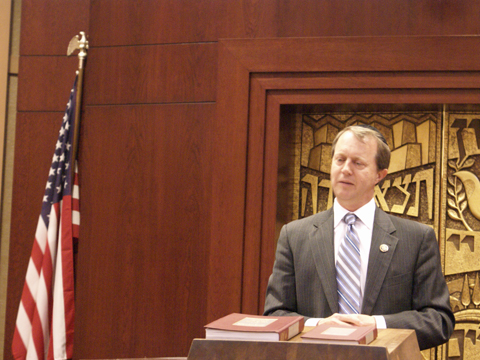
Last night, I attended a rally meeting at a large synagogue in Voorhees where John Adler spoke and answered questions about Israel and the situation in the Middle East.  The meeting appears to have been sponsored by AIPAC and there were about 100 people in attendance.  While American Jews have as much diversity of viewpoint on Israel’s policies as do the Israelis themselves, this audience was clearly aligned with the right wing, as is the current government in Jerusalem.

Adler gave a short talk followed by questions and answers, although many of the “questions” were more like speeches from the audience.  Adler’s talk started off with a discussion on two meetings he had with President Obama (including one on Air Force One) on our policy toward Israel.  The congressman asserted that he and several of his colleagues impressed upon the president that some of Obama’s early rhetoric was encouraging Israel’s enemies, and that while the United States was putting pressure on the Jewish State to change its policies, no similar pressure was being imposed on other players in the region.  While Adler feels that some progress has been made in moving the president toward a stance that is both pro-Israel and in the best interests of the United States, he called these advancements “baby steps”.  He cited the president’s tempered response to the recent flotilla incident as evidence that the message is getting across. 

In response to a question from the audience, Adler agreed with those present that the mainstream press often portrays Israel’s actions in a negative light.  He said that the United States should take some sort of action with regard to some of our allies’ actions to withdraw their ambassadors from Israel, but felt this should be done privately and diplomatically.

Clearly, the audience’s biggest concern was the Iranian nuclear capability.  Adler understands the technical and political difficulties in a military solution, and would like to see more pressure put on Iran through sanctions, diplomatic means, and covert actions.

Adler is staunchly pro-Israel, and he indicated that most other members of Congress are also.  I came away with the impression that Adler’s approach is not a “knee-jerk” one, but that he clearly understands the subtleties and potential traps in approaching the necessary support of Israel with blinders on.  No doubt, Jon Runyan will espouse a similar pro-Israel position.  But the question is whether or not Runyan understands the nuances enough to effectively promote the interests of the United States and of Israel.  Perhaps one day, Runyan will face tough questions at a news conference.  I’m not holding my breath.