Monday, August 10, 2015

The Persistence of Christie's Legacy

As Chris Christie’s presidential ambitions (at least for 2016) begin to unravel, his legacy as governor is simultaneously being formed. Due to some of his more egregious actions, that legacy will weigh heavily in New Jersey for decades to come.

Numerous aspects of life in the Garden State will be reflected in his legacy – women whose health has been compromised, pipelines through pristine, environmentally fragile areas, and an educational system that has badly deteriorated.

This morning, the Senate Legislative Oversight Committee heard testimony about another Christie blunder that will have a significant deleterious impact on the economy and quality of life for New Jersey residents.

Stephen Gardner
Stephen Gardner, Executive Vice President of Northeast Corridor Business Development at Amtrak, discussed the problems with New Jersey’s aging rail infrastructure with emphasis on the 105-year-old Trans-Hudson tunnels that bring trains into Manhattan. (Opeated by Amtrak, these tunnels are the sole entry into Manhattan for NJ Transit.)

Construction of additional tunnel capacity was underway when Christie assumed office. But in October 2010, he unilaterally and abruptly cancelled the project. His basis was unsubstantiated claims that massive overruns were about to occur, creating too big a burden to New Jersey taxpayers. Had he not taken this action and allowed ARC to continue, we would see some capacity relief around 2018. But that’s not going to happen.

The existing tunnels are running at capacity, leaving precious little time for standard maintenance of deteriorated tracks and electrical wiring. After Hurricane Sandy, the tunnels were flooded and there was no backup.  The system that carries 17% of New Jersey’s Manhattan commuters was shut down for four days at untold economic expense.

A new project, dubbed Gateway, is in the planning stages. It would build two new tunnels, allowing the existing ones to be closed for one year for much-needed rehabilitation. This could take as long as 15 years. Then, our trans-Hudson capacity would be doubled. Everyone agrees it needs to be done. But Congress (which funds 80% of the project) has yet to come up with any real money.


As Gardner explained, part of the problem is that Congress allocates capital funds on an annual basis, making a ten-year improvement program difficult to plan.  What Gardner failed to mention is that right after Christie’s ARC tunnel misstep, the Tea Party congress took over, making it an order of magnitude harder to get any required infrastructure project funded.

Saturday, August 8, 2015

Just Because its Legal Doesn't Mean its Ethical

Like many of us, I receive a slew of e-mails from politicians asking for my money. I guess they feel that they don’t receive quite enough from the corporation-persons that wine and dine them as well as fill their campaign coffers.

Most of these solicitations are annoying, but having just worked on a Congressional campaign, I know that they are part of the electoral game. But a solicitation I received this week from Congressman Tom MacArthur was particularly galling.

The letter opened as follows:

I'm leaving for Israel tomorrow. I think that it is important that I go there, meet with Prime Minister Netanyahu in person and get a firsthand understanding of just how bad this Iran deal is going to be.

This is wrong on so many levels:

  • If Congressman MacArthur already has his mind made up that this is a “bad deal”, why go on a fact-finding mission in the first place? Then it just becomes another congressional boondoggle.
  • Congressman MacArthur is using a critical and sensitive element of U.S. foreign policy not for any policy reason, but simply to raise funds for his re-election.
  • He doesn’t even need the money. He raised virtually no money from contributors for his last election, instead self-funding his campaign to the tune of $5 million – the most expensive congressional campaign in 2014.
  • The junket is not being paid for by the taxpayer, but instead by AIPAC, a far-right organization. MacArthur made no indication that he would also be meeting with any pro-Israel peace organization (such as the Israeli intelligence and military operatives who say that President Obama’s peace deal should be approved). Why travel all that distance without hearing all sides of the argument?

AIPAC invited every freshman congress member to this junket. Fifty-seven freshmen, from both parties, are going. Only three are not.

Those who are opting to attend by accepting AIPAC’s invitation are in essence taking a bribe – a trip to a wonderful historic and spiritual place. Since Congress writes the rules, this bribe is perfectly legal. But like many things in Washington (and Trenton) that are legal, the ethics of accepting this trip from a strong lobbying organization are dubious. Especially, as in the case of MacArthur, you are going there with a closed mind and using it to raise money.

Friday, July 31, 2015

Poor Acting

For the past two years, New Jersey has not had an Attorney General. John Hoffman was elevated to the post of Acting Attorney General when Governor Christie appointed Jeff Chiesa to the United States Senate to fill the seat of Frank Lautenberg.
The Attorney General is supposed to be the people's top government attorney, not the governor's. The Governor has his own chief counsel whose office is in the same State House suite as Christie's.

Government is based on checks and balances, and in New Jersey the Senate vets the governor's nominee for AG. But Christie has circumvented the state constitution by leaving Hoffman in the acting position for far too long.

Hoffman's lack of concern for the people he is supposed to be working for is exemplified by his stubborn defense of the Exxon Mobil giveaway settlement. Instead of defending the governor's blunder, he should be advocating for the people and the environment in New Jersey.

In many states, the people elect the Attorney General. But that's not the solution to our problem. With money rather than principle being the prime factor in our electoral process, an elected AG would turn into an auction, with the job going to the highest bidder.

Governor Christie should obey the letter and the spirit of the state constitution and submit a nominee to the state senate for vetting. Whether it's Hoffman or someone else, the nominee would receive a hearing and be questioned by both parties. Public input would also be part of the process. That's the way the system is supposed to work.  At least that's how it should work for a chief executive who respects the constitution and the rule of law.

originally posted on BlueJersey.com

Thursday, May 7, 2015

Too Big to Sue?

After the New Jersey Department of Environmental Protection proposed an eight-billion dollar lawsuit based on Exxon's despoiling of numerous sites in New Jersey, the Christie administration is pushing through a $225 million settlement - less than three cents on the dollar - ending any future remediation or consideration for Exxon's pollution.

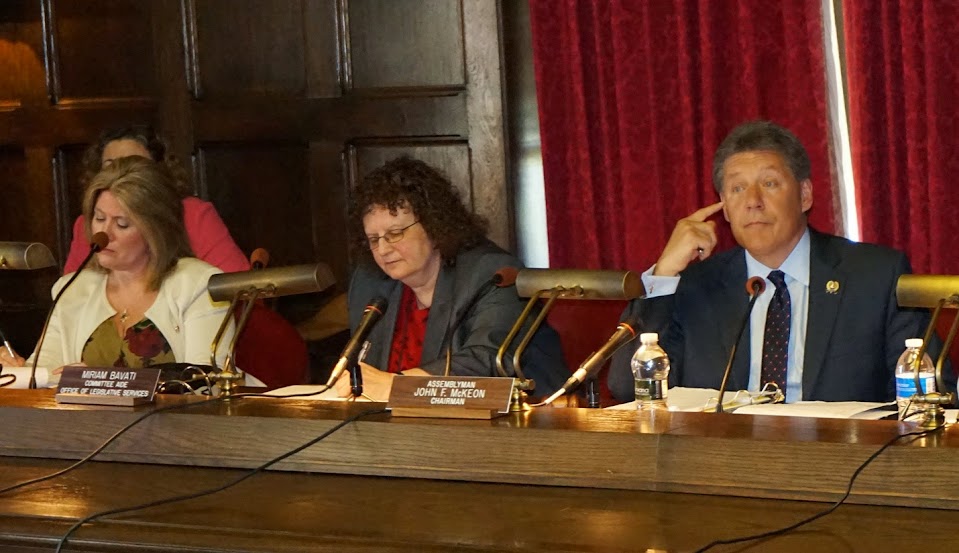
Today, Assemblyman John McKeon, chair of the Assembly Judiciary Committee, held a hearing to gather facts to try to determine if this settlement is in the best interests of the public.

While such a low cash settlement without much public discussion may seem odd, it makes sense if you look at it through the lens of Governor Christie's political aspirations. Settling for the low number now, and channeling most of that money into the general fund,  provides Christie with another one-shot gimmick to enable him to boast of a balanced budget, even though that goal is constitutionally required. Waiting for prolonged litigation to force Exxon to pay its fair share would not help Christie, who will be long out of office by the time the lawsuits are settled.

Most of the key players in the Exxon giveaway were invited to provide comments. Exxon declined. Acting Attorney General John Hoffman declined. Department of Environmental Protection Commissioner Bob Martin declined. While all gave as a reason the pending lawsuit, the Christie administration's actions in most issues like this have never been transparent.

As Assembly McKeon pointed out, not only has the proposed monetary award been drastically reduced, but many more polluted properties have been added to the settlement. Some of this information is just coming out right now, and with only a month left in the public comment period, that is a concern.

Further clouding the issue is Governor Christie's repeated grandiloquence at his taxpayer-funded political rallies stating that Exxon will pay every penny that is required to clean up the sites. As with most of Christie's pronouncements, there is a grain of truth here, but only a grain in a silo-full of problems. What Christie ignores is what the lawyers call Natural Resource Damages (NRDs). It's one thing for Exxon to put a layer of dirt on top of a polluted site, but NRD settlements compensate citizens and the state for damages to wetlands, wildlife, and water tables that are caused by the polluters, and requires a more robust (and expensive) cleanup. Otherwise, another hurricane or other disaster could breech inadequate protection, and environmental problems are back. Assemblyman McKeon pointed out that under Governor Corzine, there were 150 NRD settlements - under Christie only one.

Carrying the (somewhat polluted) water for the Christie administration at the hearing was Assemblywoman Holly Schepisi. She started off with an incredulous rhetorical questions - why are we (the legislature) trying to second-guess the work of the experts in the DEP involved in the settlement? She and her Republican colleague, Assemblyman Michael Patrick Carroll, repeatedly referred to other drawn-out lawsuits involving Exxon and wondered if holding out for a better settlement for the taxpayers over the longer term was the correct strategy.

Settling for this relative small sum not only is detrimental to future generations in New Jersey, but as Assemblyman McKeon points out, it sets a bad precedent for bad actors in the future.

Photo: From today's hearing (L to R) Assemblywoman Holly Schepisi, OLS Staffer Miriam Bavati, Assembly Judiciary Committee Chair John McKeon

Thursday, January 8, 2015

What if the NRA ran the DMV?

The Economist just published a report stating that this year, more young people will die from guns than will die from car accidents. Just as the Constitution requires guns to be “well-regulated”, operating an automobile must be regulated. This got me to thinking. What if the NRA ran the DMV?

First, as they work toward elimination of common-sense gun laws, the new NRA-run DMV would abolish the need to take a test and obtain a driver’s license. Anyone could simply jump in a car and drive away. But why limit it to cars? People who want to drive motorcycles, semi trucks, or tanks down I-95 could do it without restriction.

And what about those pesky traffic lights? A red light restricts a driver’s constitutional right to go from point A to point B, so traffic lights would be abolished, too. As would speed limits.

Insurance? Who needs liability insurance? If a reckless driver hits another car, it’s obviously not his fault. After all, the only thing that will stop a bad driver with a car is a good driver with a car.

Road rage prosecutions would be a thing of the past. If someone cuts you off at a highway exit, you have the right to “stand your ground” and ram his car, give him the finger, and shoot him.


So let’s save some money and abolish the DMV and give the NRA the task of regulating driving. After all, they do such a good job with guns.

Friday, December 5, 2014

We're not America Yet

Two hundred thirty-eight years ago, America was founded on the concept of liberty and equality. Of course, that was not strictly true because we still institutionalized slavery and women were treated as second-class citizens. But America is a work in progress. While we don’t have legal slavery today, we still have a long way to go toward equal rights for all races. While the Constitution was changed (less than 100 years ago) to guarantee women the right to vote, we still have a long way to go toward pay equality and a level playing field for women.

Over the past decade, a new rights struggle has taken center stage – equal rights for LGBT Americans. As reported in today’s New York Times, a group of Democratic legislators, along with LGBT activists, is working on a bill, akin to the Civil Rights Act of 1964, to guarantee equal rights in all areas such as housing, insurance, marriage, employment, and other areas.

And why not? It’s a shame that the spirit of the Constitution has taken centuries to implement, and that we’re not done yet. And why now? As the Times article points out, “Any effort to create a new class of legally protected people … is likely to run into serious opposition from conservatives.” But the article points out that this legislation may take a decade or more to come to fruition. Social mores change. We now have marriage equality in a majority of states. Younger voters are more open to their LGBT peers. The entertainment industry is starting to portray LGBT Americans in roles that transcend their sexual orientation.

Four years ago, on this blog, I proposed a new Equal RightsAmendment that would guarantee equal rights for the LGBT community. Given the difficulty of even passing the original ERA, this new legislative solution is a better approach. Kudos to Senator Jeff Merkley, Representative David Cicilline, and others, as well as the thousands of activists who are pouring their hearts into this struggle.


Let’s not forget that the quest for equal rights for minority races and for women is not yet complete. But as we move forward, we also need to support equal rights for our LGBT fellow Americans.

Imagine

One of the iconic songs of my generation is John Lennon's "Imagine." The lyrics describe a world of people living in harmony, income equality, and peace. Of course, since the time that Adam and Eve were exiled from the Garden of Eden, the world has never been that way. But that doesn't mean we can't strive for it, even incrementally.

So let's go on an imaginary ride through recent New Jersey history. Imagine if Chris Christie's priorities were to be the governor of all residents of the Garden State instead of being singularly focused on the White House and the wealthy donors who would help get him there. Imagine if Chris Christie was a moderate Republican, and how much better we would be if he were.

Along this journey, we'll meet a few Republicans who championed initiatives that benefited all Americans, and who would probably be shunned by the right-wing zealots who have taken over their party.

One of Christie's earliest actions as governor was to unilaterally cancel the much-needed ARC tunnel - a project that would ease the congestion of rail traffic to Manhattan and create tens of thousands of much-needed jobs as the state was starting to recover from the Great Recession. Compare that to the action of Republican President Dwight Eisenhower, who championed one of the most important initiatives of the 20th century - the Interstate Highway System. Eisenhower knew the value of a robust transportation infrastructure, and even though his motives included the rapid evacuation of cities in case of a nuclear war, he also knew that rapid movement of goods across the country was vital for economic growth.

Imagine if Christie had the same empathy for the gay community as Ted Olson does. Olson is hardly a "moderate", but the former Solicitor General under George W. Bush was a tireless fighter for marriage equality, challenging the mean-spirited California Proposition 8 in court.  Had Christie not been genuflecting to the religious right with his veto, we would have had marriage equality a lot earlier, not only benefiting hundreds of same-sex couples, but also providing a much-need boost to New Jersey's economy. If it weren't for his presidential ambitions, Christie would have followed the path travelled by his fellow Republicans Diane Allen and Jennifer Beck, and devout Christiecrat Brian Stack - all of whom voted for equality.

The next Republican we meet on our journey is Richard Nixon. While Christie and Nixon can compete equally when it comes to ethical lapses, at least Nixon understood the need for clean air and water. The former President created the Environmental Protection Agency - the same agency the current crop of Republican presidential wanabees promises to disband. Christie, on the other hand, consistently sides with his dirty energy patrons, pulling out of the Regional Greenhouse Gas Initiative and putting roadblock after roadblock in front of job-creating renewable energy projects in New Jersey.

During his tenure, Christie has never been reluctant to spend money for his self-promotion, whether its his endless stream of YouTube videos or the extra 2013 election to keep his name off the same ballot as Cory Booker. Yet, he's consistently vetoed less-expensive initiatives that would upset his patrons but benefit New Jerseyans in areas such as women's health and legal aid to the poor.

Imagine a Republican "pro-business" governor who vaulted New Jersey to the top of the list of "business-friendly" states instead of the downhill descent of the past six years. Imagine a New Jersey with an employment rate better than that of neighboring states. Imagine a New Jersey that was a leader in the renewable energy of the future instead of the dirty energy of the past. New Jersey has had good governors and bad ones. Of both parties. But under Christie, we have lost many opportunities to move our state toward a better place for all of us. The 2017 election can't come soon enough as far as Drumthwacket is concerned.

"You may say I'm a dreamer / But I'm not the only one."


Originally published at BlueJersey.com